
Local serving demand
Enterprise adoption and Indian-language interfaces increase the need to serve AI workloads closer to users, data and regulated industries.
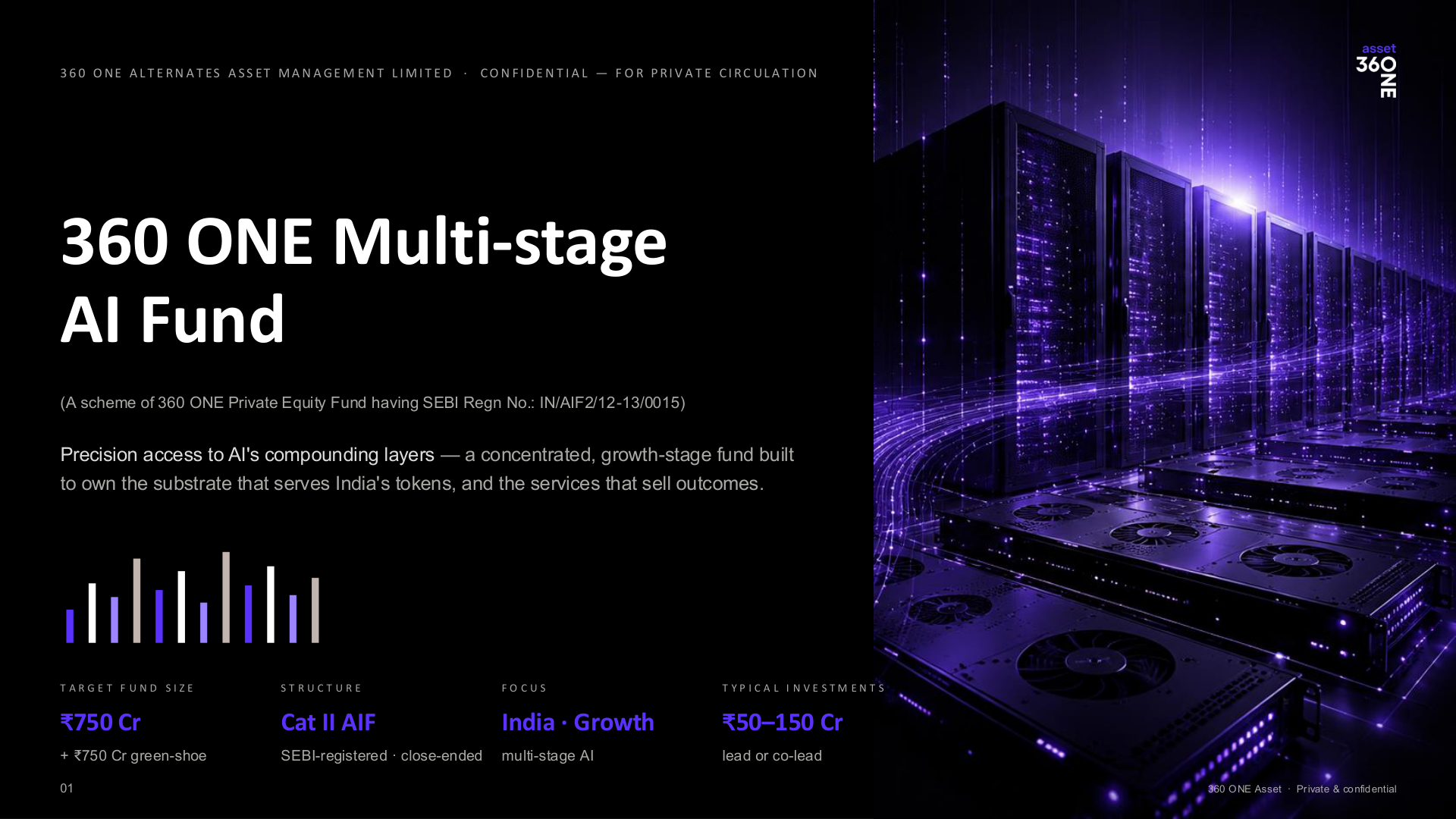
Category II Alternative Investment Fund
Precision access to India's AI infrastructure, compute and outcomes-as-a-service opportunity.
The fund is positioned as a concentrated, growth-stage AI AIF designed to own the two ends of India's inference economy: the substrate that serves tokens and the services that sell outcomes.
Managed by 360 ONE Asset, the strategy evaluates the full value chain and seeks businesses where local demand, physical constraints, enterprise workflows and execution can create durable advantages.
For investors searching for artificial intelligence AIFs in India, the page covers GenAI, enterprise AI adoption, AI-ready data centres, compute capacity, sovereign AI cloud, inference workloads and outcome-led AI services.
India Opportunity
India is a major consumer of digital intelligence, while much of the infrastructure used to produce and serve it remains concentrated elsewhere. Closing that gap can create opportunities across infrastructure and enterprise delivery.
Enterprise adoption and Indian-language interfaces increase the need to serve AI workloads closer to users, data and regulated industries.
Data centres, power, fibre, cooling and managed cloud capacity form the physical base for dependable AI delivery.
India's services heritage supports businesses combining software, domain expertise and managed delivery to produce measurable outcomes.
Localisation, latency-sensitive use cases and regulated data can make domestic serving relevant. India's services ecosystem also knows how to translate technology into business processes. The opportunity includes infrastructure beneath models and useful work delivered above them.
Investment Philosophy
The strategy separates AI into infrastructure, enablement and outcomes, applying a higher bar where rapid commoditisation can weaken durable value.
Seek useful infrastructure enabling AI workloads: compute, cloud, connectivity, power-linked assets and operating systems.
Evaluate models, data tooling and middleware where differentiation, distribution or India-specific capability can support durable economics.
Back businesses using AI to complete valuable work and price around usage, productivity or defined business results.
AI Value Chain
Value-chain mapping clarifies a company's differentiation, capital needs, competitive threats and route to monetisation.
Infrastructure layer
The foundation includes data centres, power, fibre, chips, cloud and systems software. Reliability, utilisation and customer contracts remain central.
Enablement layer
This layer turns infrastructure into usable intelligence. Open ecosystems and global capital can compress pricing and shorten product advantages.
Application layer
Value can accrue to companies integrating AI into complete workflows, owning delivery quality and demonstrating clear customer benefit.
Compute And Infrastructure
Dependable AI infrastructure requires power, cooling, fibre, data-centre operations, cloud orchestration, security and managed services. The strategy looks for scarce capacity combined with reliable execution.
Is demand supported by recurring workloads? Can the platform maintain utilisation without subsidies? Do managed services improve margins and retention? Can capacity evolve with hardware standards?
Independent infrastructure can matter where enterprises need local support, workload control or an alternative to one hyperscale provider. Neutral interconnect can support movement among data centres and clouds.
Investment cases should remain grounded in private demand and operating economics. Policy support should not replace customer evidence, capital discipline or sustainable service margins.
Outcomes-as-a-Service
Outcomes-as-a-Service businesses use AI, software and operational delivery to complete valuable work. Customers buy results or productivity rather than software access alone.
The product should solve a defined workflow problem and make the economic benefit understandable to the buyer.
Software, automation, domain expertise and human oversight can be combined where reliability matters more than full autonomy.
Retention, repeat usage, delivery quality and healthy unit economics are stronger signals than experimentation or headline adoption.
India's services ecosystem understands complex workflows and managed delivery. Strong businesses can convert that knowledge into repeatable software-led products while remaining accountable for results.
Selective Middle Stack
The middle stack is important but exposed to global research cycles, open-source alternatives and rapid replication. The approach is selective, not exclusionary.
Proprietary data rights, deep workflow integration, strong distribution, India-specific language or regulatory capability, high switching costs and a clear route to enterprise adoption can create defensibility.
Products that depend on temporary model advantages, undifferentiated wrappers, a single external platform or continued price premiums may face fast margin compression and limited bargaining power.
Growth-Stage Investment Process
The process connects sector research with company evidence, institutional diligence and a practical ownership plan.
Use research, founder networks and the wider platform to identify companies across the value chain.
Test whether each opportunity belongs to infrastructure, enablement or delivered outcomes.
Assess demand, differentiation, governance, customer evidence, capital intensity and exit paths.
Seek meaningful ownership, appropriate protections and governance access.
Support customer access, capital planning, future financing and institutional readiness.
Portfolio Construction
A focused growth portfolio makes entry discipline, governance, monitoring and balance across business models especially important.
Key Investment Themes
These themes are an orientation framework, not a fixed allocation or assurance that any company will enter the portfolio.
Domestic environments for secure model deployment, inference and managed AI operations.
Facilities, cooling and operating systems designed for accelerated workloads.
Fibre platforms linking data centres, cloud regions and enterprises.
Tools improving data quality, governance, retrieval and secure access.
Products completing business tasks and aligning pricing with delivered value.
Managed delivery combining domain expertise, automation and human oversight.
Risk Framework
AI investing combines private-market risk with fast technology cycles. This summary does not replace official risk factors.
Fast-changing architectures require scrutiny of interoperability, upgrade paths and vendor dependence.
Contract quality, customer concentration, utilisation and service margins require close attention.
Retention, workflow integration and repeatable delivery should support assumptions about scale.
Financing plans, operating discipline and milestone-based capital deployment must be evaluated carefully.
Data rules, power, semiconductor supply and cross-border restrictions can affect operations.
Exit planning should consider strategic buyers, sponsor demand and public-market readiness.
Investor Suitability
This private-market strategy requires review of portfolio fit, liquidity needs, experience and ability to bear loss.
Eligible investors who understand Category II AIF structures and private-market risk.
Investors with a long horizon who do not require regular liquidity.
Portfolios seeking exposure to India's AI infrastructure and enterprise transformation.
Investors able to tolerate concentration, valuation uncertainty and capital loss.
It is not designed for investors seeking capital protection, predictable income, short-term liquidity or guaranteed returns. Suitability requires official documents and independent professional advice.
Related AI & Tech Funds
Investors researching AI investment funds in India can compare 360 ONE Multi-Stage AI Fund with related private-market AI, deep-tech, semiconductor and digital innovation strategies before reviewing suitability, liquidity, taxation and official fund documents.
Deep-tech, semiconductors, space, defence technology and advanced electronics.
Digital innovation and growth-stage technology startups through a venture ecosystem approach.
Strategic deep-tech exposure across aerospace, defence, space and dual-use technology sectors.
For broader context, review the AIF funds section and the AIF investor guide.
It is presented as a SEBI Category II AIF focused on India's growth-stage AI opportunity across compute infrastructure and outcomes-as-a-service.
The strategy maps the stack from infrastructure and compute to applications and outcomes, focusing on the ends while remaining selective in the middle.
The thesis is that value may accrue to scarce infrastructure and businesses that turn intelligence into finished work. Middle layers can face intense global competition and commoditisation.
It describes providers using AI to deliver completed business results, with value linked to usage, productivity or finished work rather than software access alone.
Yes. The page positions the strategy around artificial intelligence themes such as GenAI, enterprise AI workflows, AI infrastructure, compute capacity, inference demand and outcome-led AI businesses.
360 ONE Multi-Stage AI Fund is narrower and more AI-focused, while broader technology AIFs may also cover semiconductors, defence technology, space technology, advanced electronics and digital infrastructure.
No. A company may be considered where defensible technology, proprietary data, distribution, workflow lock-in or India-specific capability supports durable economics.
Risks include concentration, illiquidity, technology change, execution, capital intensity, adoption, supply chains, regulation and uncertain exits. Official risk factors should be reviewed fully.
No. Suitability depends on eligibility, risk appetite, liquidity needs, investment horizon, tax position and a complete review of official documents.
No. Returns are not promised or guaranteed. Investments are illiquid and investors can lose capital.
Next Step
Connect with BlackSwan Securities to request official fund documents and evaluate whether the strategy fits your risk profile, investment horizon and allocation plan.
This page is for informational purposes only and does not constitute investment advice, an offer or a solicitation. Fund strategy, portfolio construction, pipeline and commercial terms are indicative and may change. Investments in AIF units are illiquid and carry risk of capital loss. Investors should read the official PPM, contribution agreement and risk factors, and consult legal, tax and financial advisors before investing.