
Capital needs in listed companies
Listed businesses may require capital for expansion, deleveraging, acquisitions, capacity creation or balance-sheet strengthening.

Category III Alternative Investment Fund
A research-led PIPE strategy focused on listed-equity, negotiated and special-situation opportunities.
360 ONE PIPE Fund Series 2 is positioned as a Category III AIF in India for investors evaluating PIPE investing, or Private Investment in Public Equity. The approach focuses on listed companies where negotiated transactions, preferential allotments, block participation or special situations may offer differentiated entry points.
About Fund
360 ONE PIPE Fund Series 2 is a Category III Alternative Investment Fund designed around a PIPE-based investment approach in Indian public markets. The strategy focuses on listed-equity opportunities where capital can be deployed through negotiated or special-situation routes, including preferential participation and other permitted transactions. The fund's approach is research-led and selective, with emphasis on business quality, governance, transaction structure, entry valuation and execution capability. PIPE investing can allow institutional investors to evaluate listed companies with a private-equity style lens while still operating within a listed-market framework. Portfolio construction is expected to be focused rather than benchmark-led, with investments selected based on fundamental conviction and the attractiveness of the specific opportunity.
PIPE Investing
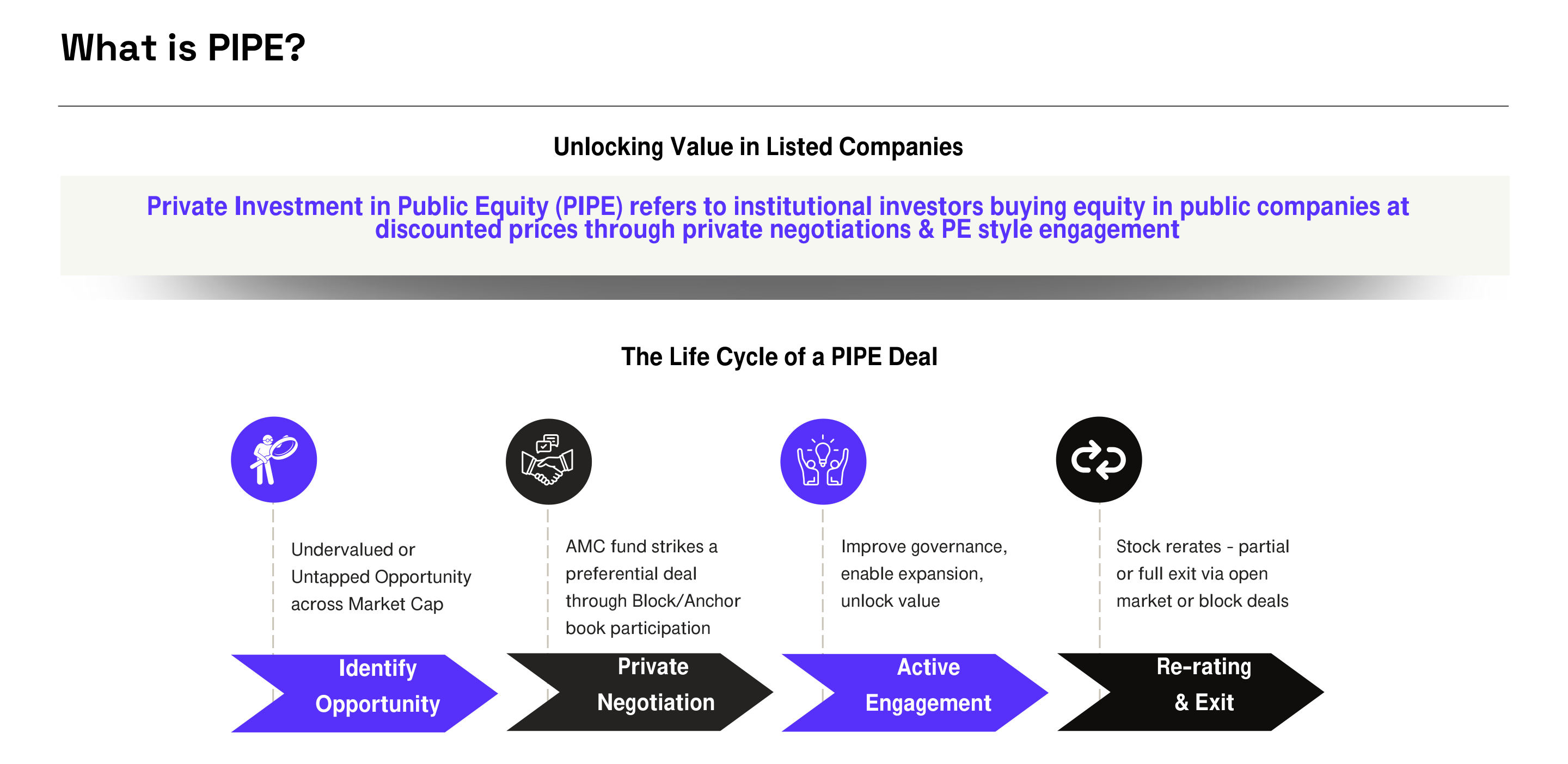
Private Investment in Public Equity, or PIPE, refers to an investment by institutional investors in a listed company through a negotiated transaction. The investment may happen through preferential allotment, block participation, anchor transactions or other permitted structures.
PIPE capital can support growth, capacity expansion, acquisitions, governance improvements or balance-sheet strengthening. The key assessment is not only the public-market price but also the entry valuation, terms of participation, company quality, liquidity and execution risk after capital is deployed.
India Opportunity
India's listed markets include many companies with growth ambitions, balance-sheet needs and expansion opportunities that may not always be fully captured by broad institutional coverage. Mid- and small-cap businesses can present gaps in research depth, capital access and investor engagement.
PIPE investing can apply private-equity style evaluation to public companies while retaining listed market transparency and potential liquidity. The opportunity depends on disciplined governance review, valuation analysis, transaction execution and ongoing monitoring. It should not be viewed as a lower-risk substitute for ordinary equity investing.
Listed businesses may require capital for expansion, deleveraging, acquisitions, capacity creation or balance-sheet strengthening.
Mid- and small-cap companies can be less widely covered by institutions, making deep primary research and governance assessment important.
PIPE opportunities may arise around promoters, corporate actions, recapitalisation, growth funding or sector-specific expansion cycles.
The approach can combine private-equity style diligence and engagement with the transparency and exit routes of listed markets.
Sector Opportunities
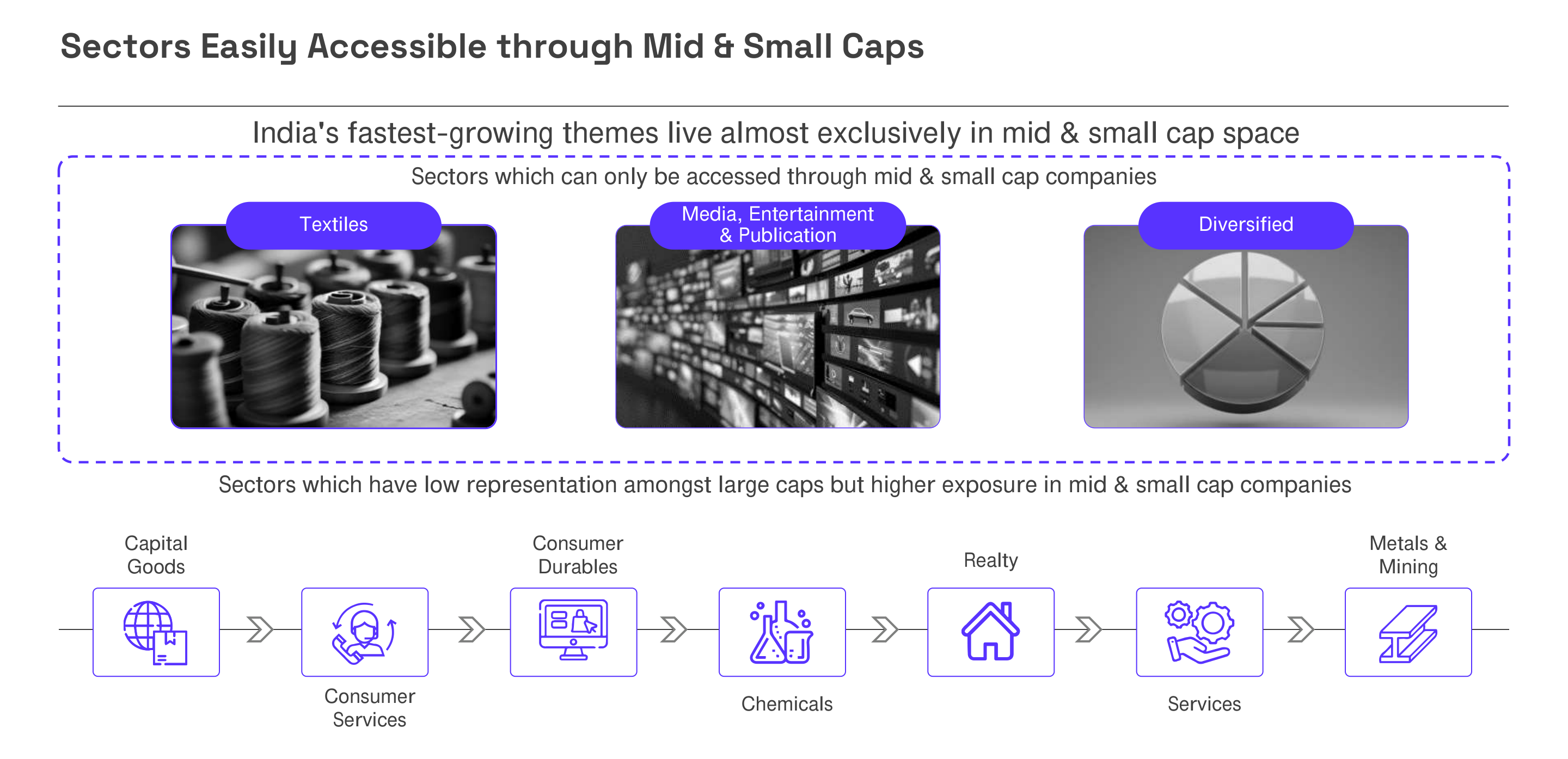
The opportunity universe may include sectors that are more visible in the mid- and small-cap market than in large-cap indices. This does not mean the fund will invest in every sector or maintain a fixed sector allocation.
Investment Philosophy
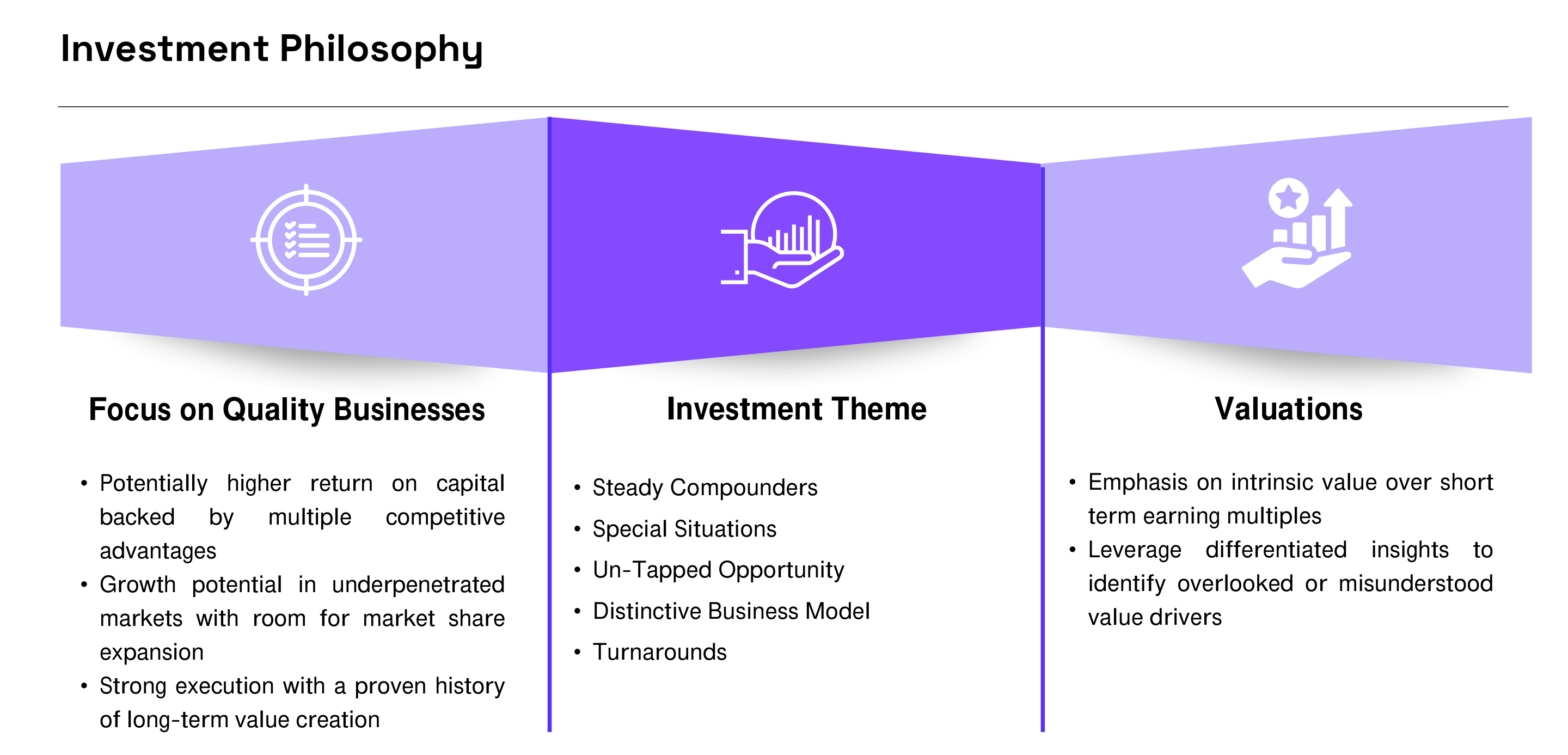
The strategy is built around quality businesses, differentiated investment themes and valuation discipline. The focus is on competitive advantages, underpenetrated markets, execution capability, steady compounders, turnaround situations and intrinsic value.
Preference for companies with competitive advantages, strong execution capability and potential for long-term value creation.
Research can consider steady compounders, underpenetrated markets, turnaround situations and distinctive business models.
Emphasis on intrinsic value, entry valuation and differentiated insights rather than relying only on short-term earnings multiples.
Investment Process
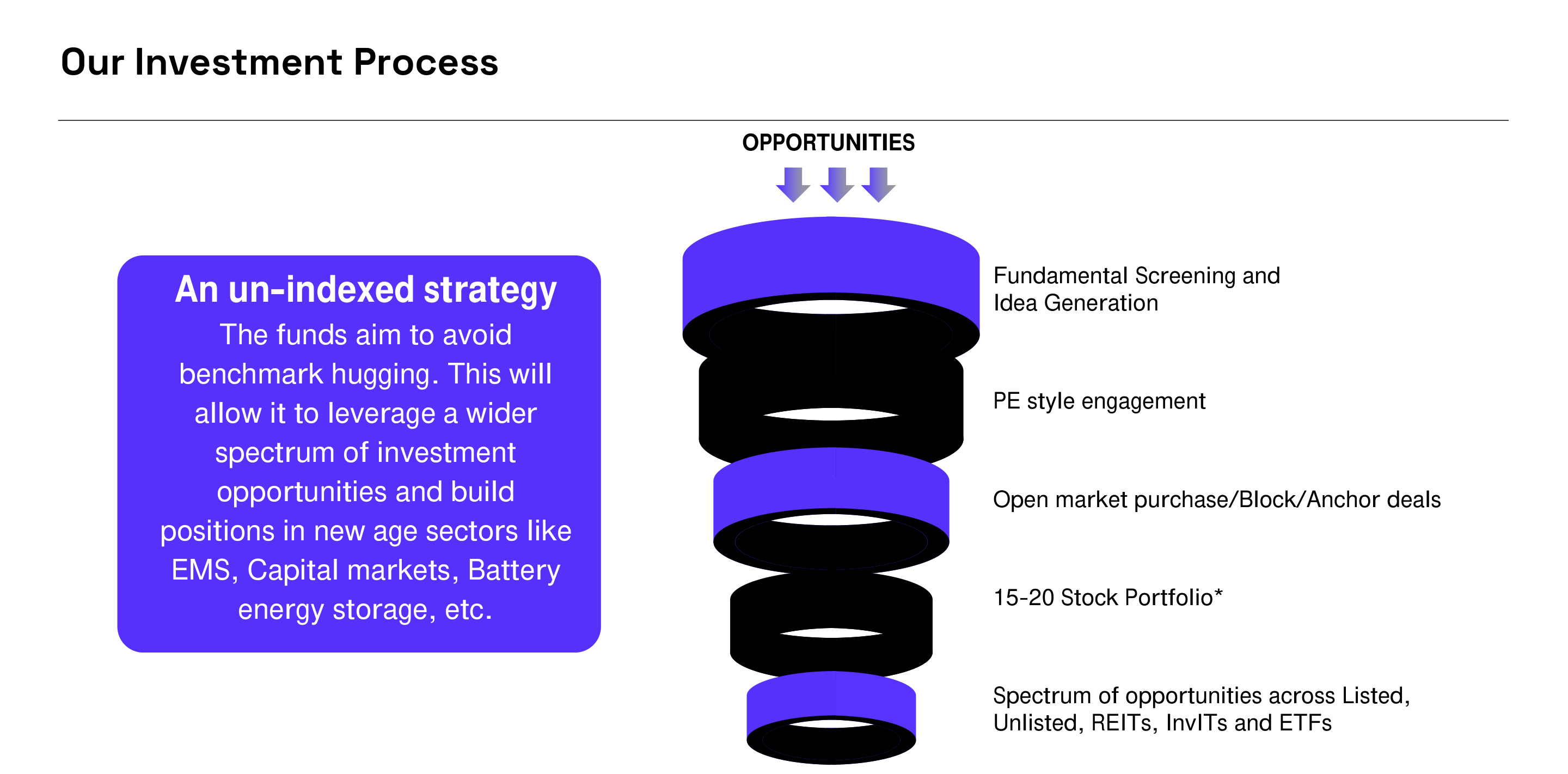
The process is designed to move from opportunity identification to transaction participation and ongoing portfolio monitoring. Website language refers to a focused portfolio rather than a fixed stock count, since portfolio size can vary with market conditions and available opportunities.
01
Source PIPE, block, anchor, preferential and special-situation opportunities across the listed universe.
02
Evaluate business quality, industry structure, financial strength, governance and suitability for deeper work.
03
Assess management, competitive advantages, capital use, valuation, downside cases and transaction terms.
04
Engage with companies where appropriate to understand strategy, governance, expansion plans and execution readiness.
05
Participate selectively through permitted routes such as preferential allotments, block deals or anchor transactions.
06
Monitor business delivery, liquidity, valuation and rerating potential while assessing partial or full exits.
Portfolio Universe
Subject to official documents, the fund may evaluate a broad opportunity universe across listed and related market instruments. Specific stock names, case studies and return examples are intentionally not shown here.
Suitability
This strategy may be evaluated by eligible HNI and sophisticated investors who understand equity risk, transaction complexity and concentrated portfolio exposure.
Investors should evaluate suitability with their independent financial, tax and legal professionals.
360 ONE PIPE Fund - Series 2 is presented as a Category III Alternative Investment Fund focused on Private Investment in Public Equity opportunities, including listed-equity, negotiated transaction and special-situation opportunities subject to official fund documents.
PIPE stands for Private Investment in Public Equity. It generally refers to institutional investment in a listed company through privately negotiated or structured routes such as preferential allotments, block transactions or anchor participation.
The fund presentation identifies 360 ONE PIPE Fund - Series 2 as a scheme of 360 ONE Opportunities Fund, a Category III AIF. Investors should verify registration, structure, terms and current details in the latest official documents.
The opportunity universe may include listed equities, preferential allotments, block and anchor transactions, special situations, select pre-IPO opportunities, REITs, InvITs and other permitted securities subject to official documents.
No. Mid- and small-cap companies may provide a broad opportunity universe, but this page does not imply a fixed sector or market-cap mandate. Actual investments depend on the fund documents, opportunity availability and manager assessment.
Key risks include equity-market volatility, liquidity risk, concentration risk, valuation risk, transaction execution risk, governance risk and the possibility that expected rerating, expansion or exits do not occur.
Yes. A PIPE AIF and a PIPE PMS strategy can differ in legal structure, pooling, taxation, documentation, portfolio ownership, eligibility, reporting and operating framework. Investors comparing this AIF with a PMS PIPE Strategy should review both sets of documents independently.
Eligible HNI and sophisticated investors with a long-term horizon, tolerance for equity volatility and understanding of concentrated strategy risk may evaluate the strategy with independent financial, tax and legal professionals.
Connect with BlackSwan Securities to request official documents and discuss whether the strategy fits your objectives, risk profile and investment horizon.
This page is for informational purposes only and does not constitute investment advice, tax advice, legal advice, an offer or a solicitation. Alternative Investment Funds and securities-market investments are subject to market risk, liquidity risk, valuation risk and potential capital loss. No return is assured or guaranteed. Strategy details, eligible instruments, portfolio construction, risk factors, fees, taxation and terms are governed by the latest official fund documents. Investors should read the private placement memorandum and related documents and consult independent financial, tax and legal professionals before making any decision.