
Late-Stage Opportunities
Focus on businesses that may be approaching later stages of private-market growth.
Category II Alternative Investment Fund
Late-Stage Private Equity & Growth Opportunities in India
The strategy focuses on opportunities in businesses approaching later stages of their growth journey, where companies may have established operating models, clearer business visibility and a more developed institutional profile.
For HNIs, NRIs and family offices evaluating private-market exposure, late-stage private equity can sit between early growth investing and public-market participation, with potential pathways toward public markets or other liquidity events.
Fund Overview
Late-stage private equity typically focuses on growth-stage businesses that have progressed beyond early venture risk and may have established products, operating models and customer traction.
For investors evaluating a pre-IPO AIF in India, the IIFL Late-Stage Private Equity Fund is positioned around pre-IPO and later-stage growth opportunities, where private companies may be preparing for deeper institutional capital, governance evolution or future public-market participation.
Investors should evaluate this opportunity as a private-market allocation with longer horizons, document-specific terms and risks that differ materially from listed equity investing.
Focus on businesses that may be approaching later stages of private-market growth.
Evaluate companies with clearer operating visibility and room for future expansion.
Emphasise structured assessment before committing capital to private-market opportunities.
Maintain a patient perspective across scaling, governance and potential liquidity pathways.
Investment Lifecycle
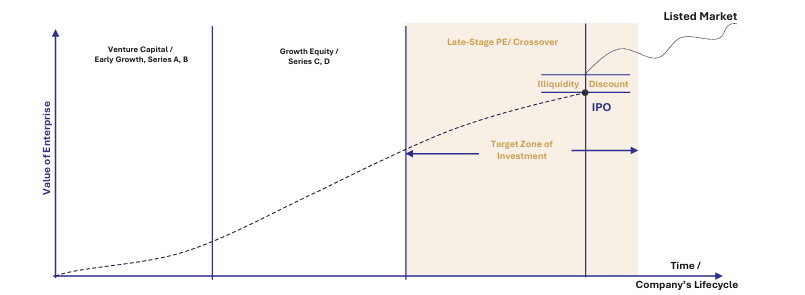
The private-market lifecycle can move from Venture Capital to Growth Equity, then Late-Stage Private Equity or crossover participation, followed by IPO and listed-market ownership.
Late-stage private equity occupies a distinct position between traditional growth investing and public-market participation. Businesses at this stage may have greater operating maturity and visibility compared with much earlier-stage ventures, while still potentially participating in future expansion.
Opportunity
Later-stage businesses may have more mature business models, established products or services and clearer operating evidence than companies at the earliest stages of formation.
The opportunity set may include businesses seeking institutional capital for expansion, professionalisation, governance depth or potential transition toward public markets. These pathways are possible outcomes, not guarantees.
Later-stage businesses may have more established products, services and customer behaviour than early ventures.
The stage can offer better visibility into business model quality while retaining expansion potential.
Capital may support governance, reporting depth and readiness for larger institutional participation.
Exit routes may include strategic transactions, secondary liquidity or public-market transition, subject to conditions.
Investment Framework
The STAR framework communicates a disciplined investment selection approach. It is designed to evaluate market size, company leadership, financial quality and valuation together rather than relying on a single factor.
Each element is considered in context so that opportunity quality, company strength and valuation discipline remain connected through the investment evaluation process.

S
Focus on businesses participating in markets with structural growth prospects.
T
Look for companies with strong market positioning and differentiated customer value propositions.
A
Assess business economics and capital efficiency as part of investment evaluation.
R
Evaluate valuation in the context of business growth prospects and capital efficiency.
Focus Industries
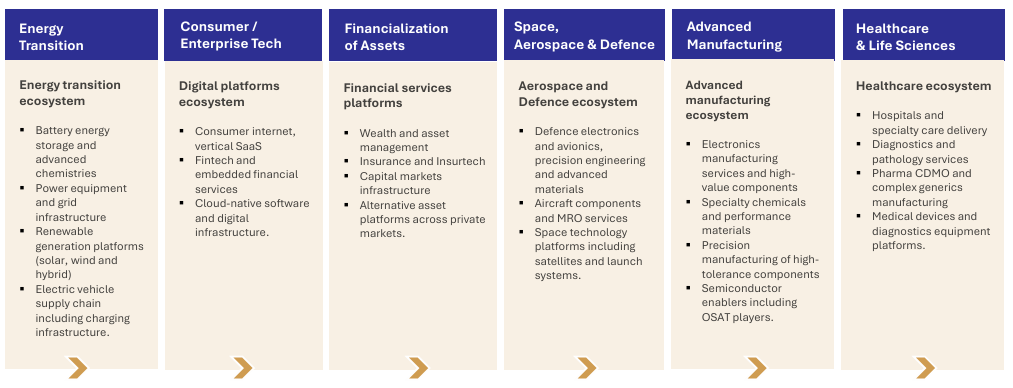
The fund presentation highlights a set of long-term industry themes where late-stage private companies may benefit from structural change, institutional capital and market expansion.
These sectors are shown as illustrative focus areas and should be read alongside the official fund materials and investment documents.
Investment Approach
01
02
03
04
05
06
Governance
Private-market investing requires detailed evaluation of the business, management, financial profile, industry environment and transaction structure before any allocation is considered.
A disciplined process also continues after investment, with ongoing monitoring of company progress, governance quality and changes in the broader market environment.
BlackSwan Securities
BlackSwan® Securities helps eligible HNI, NRI and family office investors explore curated PMS and AIF opportunities with attention to investor suitability, long-term perspective and transparent communication.
BlackSwan® Securities is not presented as the fund manager. Investors should review official fund documents, understand risks and assess whether the strategy is suitable for their objectives.
The IIFL Late-Stage Private Equity Fund is relevant for investors researching late-stage private equity in India, Category II AIF structures and private-market growth opportunities beyond listed equities.
Late-stage private equity and pre-IPO investment opportunities in India may appeal to sophisticated investors seeking exposure to growth equity, private companies and businesses preparing for deeper institutional capital participation.
For HNI, NRI and family office investors, a private equity fund in India should be assessed within a broader private-market allocation, with attention to liquidity, risk, documentation and suitability.
Investors comparing Alternative Investment Funds in India should review strategy, suitability, liquidity, taxation and official documentation. Useful starting points include our pages on Alternative Investment Funds, AIF returns and AIF taxation.
The IIFL Late-Stage Private Equity Fund is presented as a Category II Alternative Investment Fund focused on late-stage private equity and growth opportunities in India, subject to the official fund documents.
Late-stage private equity generally refers to investments in private companies that have moved beyond early venture stages and may have established operating models, clearer business visibility and potential routes toward larger liquidity events.
Venture capital often backs earlier-stage companies where product-market fit and scale may still be developing. Late-stage private equity usually focuses on more mature private businesses with stronger operating evidence.
The presentation highlights themes such as energy transition, consumer and enterprise technology, financialisation of assets, space, aerospace and defence, advanced manufacturing, and healthcare and life sciences.
The STAR framework evaluates Sizeable market opportunity, Top-tier leadership, Attractive financial metrics and Reasonable valuation as part of disciplined investment selection.
Listed equity investing involves publicly traded securities with daily market pricing. Late-stage private equity involves private companies, typically with longer holding periods, lower liquidity and more document-specific risk factors.
Category II AIF opportunities are generally considered by eligible sophisticated investors such as HNIs, NRIs, family offices and institutions, subject to suitability, KYC and official fund documentation.
Investors can connect with BlackSwan Securities to request official fund details and discuss the strategy, structure, suitability and participation process with the team.
Next Step
Connect with BlackSwan® Securities for detailed information regarding the fund's investment strategy, structure and participation process.
Alternative investments involve risk. Past performance does not guarantee future results. This information is provided for informational purposes only. Investors should review official fund documents and obtain appropriate professional advice before making an investment decision.