
MMR residential focus
The fund presentation positions the strategy around Mumbai Metropolitan Region residential projects in prime micro-markets.
Category II Alternative Investment Fund
A residential development AIF focused on Mumbai Metropolitan Region real estate and redevelopment-led housing.
ICICI Prudential Real Estate Development Fund India is positioned as a Category II real estate AIF in India for eligible investors evaluating residential real estate, Mumbai redevelopment AIF opportunities and project-level real estate investment strategy. The fund deck identifies it as a scheme under ICICI Prudential Real Estate AIF, registered with SEBI as a Category II AIF.
About Fund
ICICI Pru Real Estate Development Fund is a residential real estate AIF focused on development and redevelopment opportunities in MMR. The page language intentionally keeps the fund positioned as an Indian real estate alternative investment fund, not as a direct property purchase, real estate mutual fund or guaranteed-return product.
The fund proposition in the deck refers to a target fund size of INR 1,000 Cr plus a green shoe option of INR 1,000 Cr, a fund tenor of 6 (+1+1) years from first closing and target investors including HNIs, family offices and institutions. All terms are subject to the latest PPM and contribution documents.
The fund presentation positions the strategy around Mumbai Metropolitan Region residential projects in prime micro-markets.
The deck describes the fund as a close-ended Category II AIF with a term of 6 years plus two possible 1-year extensions.
The investment target is primarily residential projects, including redevelopment-led housing opportunities subject to official fund documents.
The stated target investors include HNIs, family offices and institutions that can evaluate private market real estate risk.
Fund Proposition
The deck presents the fund as a close-ended Category II AIF focused on residential projects, with a Mumbai Metropolitan Region focus and target investors that include HNIs, family offices and institutions.
Any target gross IRR or target multiple shown in deck material is indicative, gross of fees and expenses, and is not a guarantee or assurance of future performance.
MMR Focus
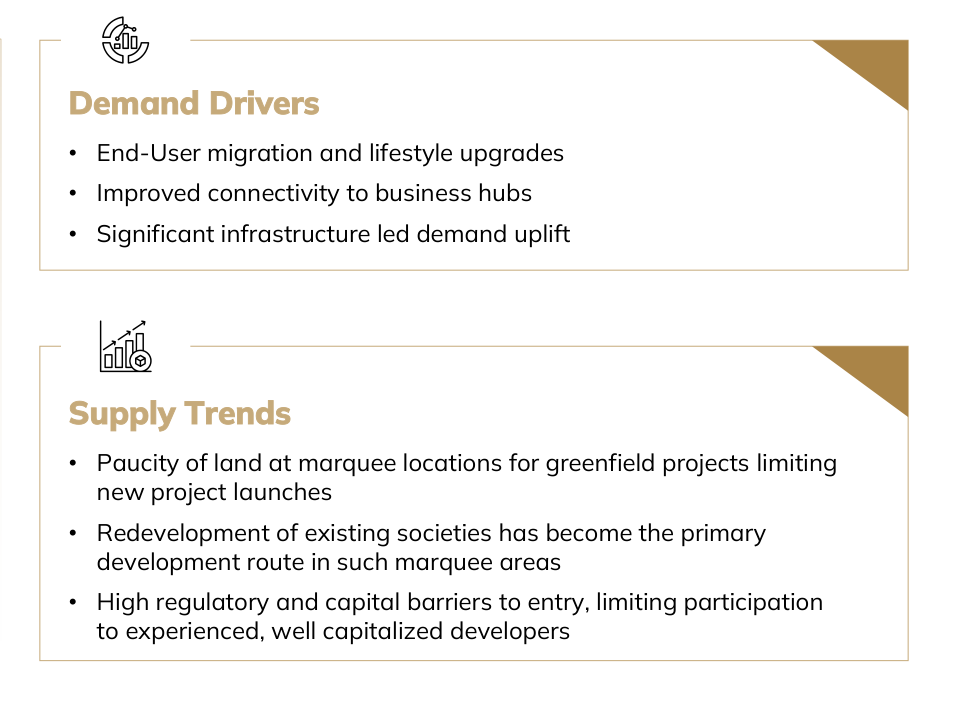
The deck identifies MMR as a large residential market with end-user migration, lifestyle upgrades, connectivity improvements and infrastructure-led demand drivers. This makes Mumbai residential real estate fund, MMR residential development fund and Mumbai Metropolitan Region real estate fund keywords relevant to the public positioning.
Supply-side constraints in marquee locations can make redevelopment an important development route, but project selection and execution discipline remain central to risk management.
Redevelopment
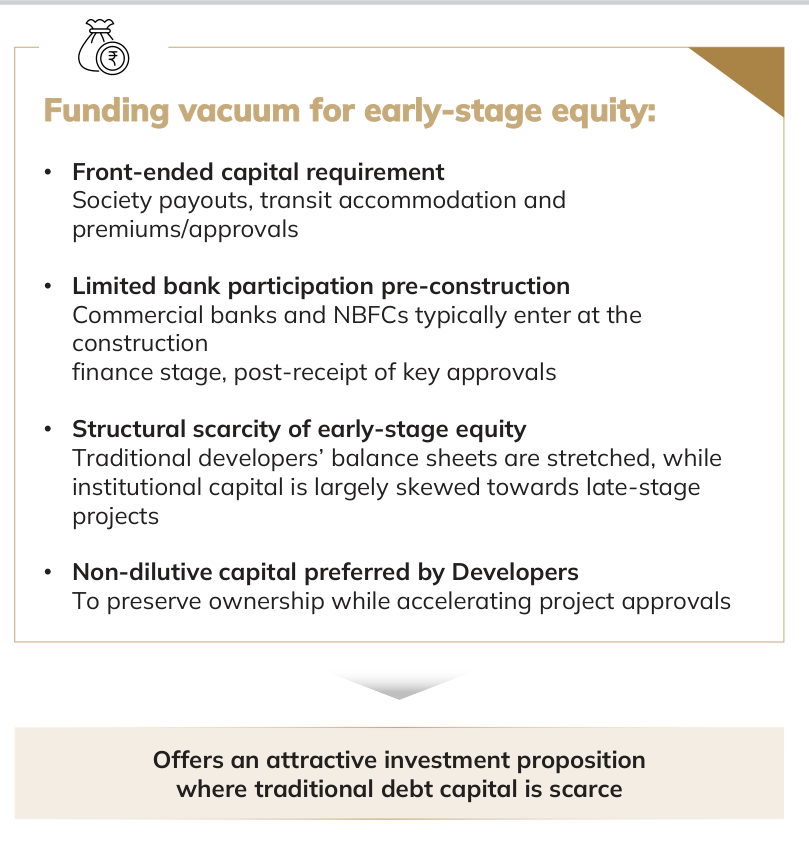
The presentation links Mumbai redevelopment to early-stage financing needs such as society payouts, transit accommodation, premiums and approvals. That supports the relevance of terms like Mumbai society redevelopment fund, Mumbai housing redevelopment investment and residential redevelopment projects in MMR.
Redevelopment-led housing can involve legal, technical, approval, construction, sales and developer performance risks. Investors should evaluate each project through the fund documents and risk factors.
Investment Platform
The investment platform combines ICICI Prudential Asset Management Company, marquee developers and marquee residential projects. The stated approach includes access to projects in high-growth micro-markets, project cash flows and exit pathways supported by developer-led buyback options.
Investment Framework
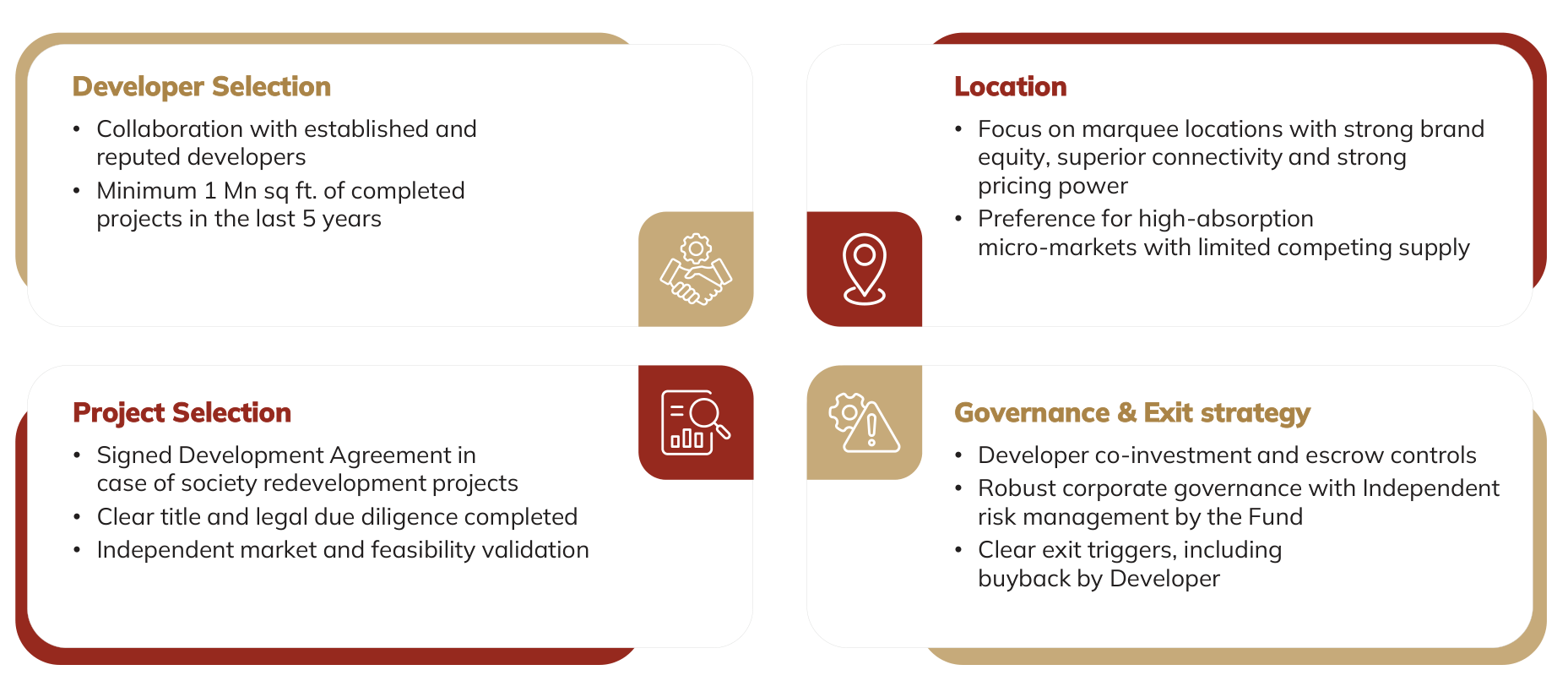
The fund deck describes a project selection and due diligence framework built around developer quality, location strength, legal review, market feasibility, escrow controls, governance and exit triggers.
The deck refers to collaboration with established real estate developers and a preference for developers with a proven execution record.
Project selection can focus on marquee locations, superior connectivity, strong brand equity and high-absorption residential micro-markets.
The investment approach refers to clear title, signed development agreements, legal review, technical diligence and independent feasibility validation.
The framework includes escrow controls, developer co-investment, independent risk management and clear exit triggers including developer buyback.
Structure
The indicative structure assigns responsibilities between the investment manager and developer, including independent diligence, cash-flow oversight, milestone monitoring, approvals, construction finance and periodic project reporting.
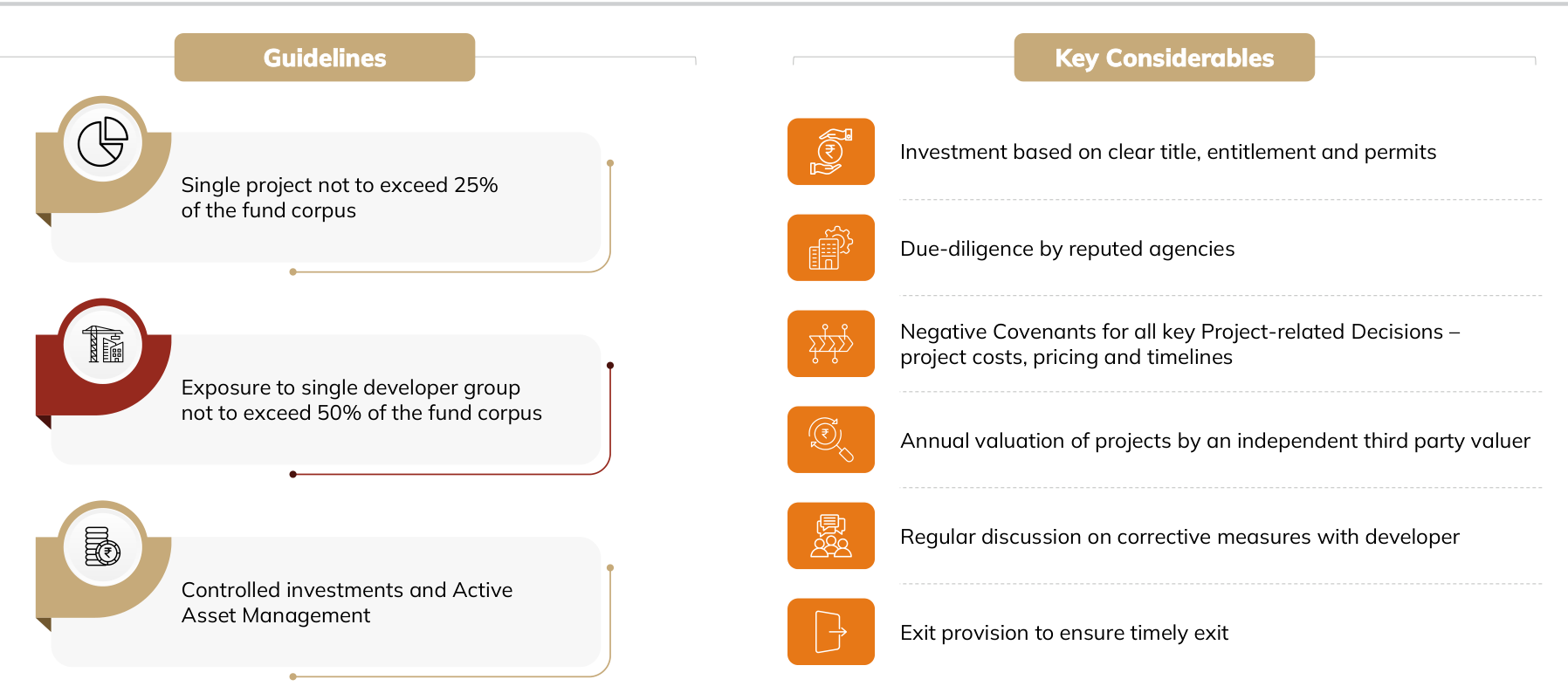
Guidelines
The deck refers to clear title, entitlements, permits, reputed diligence agencies, negative covenants, independent valuation, corrective reviews with developers, exit provisions and exposure limits across developers and projects.
Suitability
This section is informational and not a recommendation. Eligible investors may explore the strategy only after reviewing objectives, risk tolerance, liquidity needs, tax position and official fund documents.
AIF investment is not direct ownership of property. It is a fund-unit investment governed by the PPM, contribution agreement and related documents.
Risk Review
The fund deck highlights counterparty, regulatory approval, execution, market, exit and concentration risks. Investors should review detailed risk factors in the PPM and consult independent advisors.
ICICI Prudential Real Estate Development Fund is presented in the deck as a residential development fund and a scheme under ICICI Prudential Real Estate AIF, which is identified as registered with SEBI as a Category II AIF. Investors should verify current details in the latest PPM and contribution documents.
A real estate AIF in India is an Alternative Investment Fund that pools capital from eligible investors and deploys it into permitted real estate opportunities, such as residential development, redevelopment, project-level investments or real estate-linked securities, depending on the fund documents.
A Category II real estate AIF is an AIF that is not classified as Category I or Category III and generally invests in private market opportunities without routine leverage, subject to SEBI AIF regulations and the scheme's private placement memorandum.
A residential development AIF can invest at the project level with developers, monitor approvals, milestones, escrow controls, cash flows and exits. The actual structure depends on the PPM, contribution agreement and project contracts.
Mumbai redevelopment usually refers to replacing older society buildings with new residential projects. The deck highlights society redevelopment as a key supply route in marquee Mumbai locations, where early-stage equity can help fund approvals, rent, corpus and other front-ended costs.
An AIF investment is not direct ownership of a flat, land parcel or project. Investors subscribe to units of the fund, and rights, risks, fees, liquidity, reporting and exits are governed by the fund documents rather than direct property title.
A real estate AIF is typically a private pooled investment vehicle for eligible investors, while a REIT is a listed or market-traded trust structure focused largely on income-generating real estate. Liquidity, transparency, taxation, asset profile and risk can differ materially.
No. AIFs are private pooled vehicles for eligible investors and usually have different minimum investment, documentation, liquidity, fees, taxation and risk profile compared with mutual funds.
Key risks include market risk, liquidity risk, valuation risk, developer risk, project execution risk, approval delays, concentration risk, regulatory changes and potential capital loss. Investors should read the risk factors in the PPM.
Investors should review the PPM, contribution agreement, term sheet, risk factors, fee schedule, drawdown and distribution terms, taxation notes, valuation policy and any current addenda or official updates before investing.
Connect with BlackSwan Securities to request official documents and discuss whether this residential real estate development AIF fits your objectives, risk profile and investment horizon.
This page is for informational purposes only and does not constitute investment advice, tax advice, legal advice, an offer or a solicitation. Alternative Investment Funds and real estate investments are subject to market risk, liquidity risk, valuation risk, project execution risk, approval risk, counterparty risk and potential capital loss. No return is assured or guaranteed. Strategy details, eligible instruments, portfolio construction, risk factors, fees, taxation and terms are governed by the latest official fund documents. Investors should read the private placement memorandum and related documents and consult independent financial, tax and legal professionals before making any decision.